

· AFX Research
Salt and Potash Rights in the Mineral Estate, What to Check
An old reservation of oil, gas and other minerals may or may not have taken the salt with it. Why the answer changes at the state line, and what a search can establish.
Table of Contents
A landowner in Kansas gets an inquiry about leasing the salt under her land for a storage project. She has always understood that the minerals were reserved out in the 1930s, so she assumes the salt went with them. Whether it did is genuinely unsettled on the face of the deed, because the reservation says oil, gas and other minerals, and what that phrase captured depends on which state she is standing in. This is the same interpretive problem that runs through reservation clauses in old deeds, applied to a substance nobody was thinking about when the clause was written.
Whether salt goes with the minerals
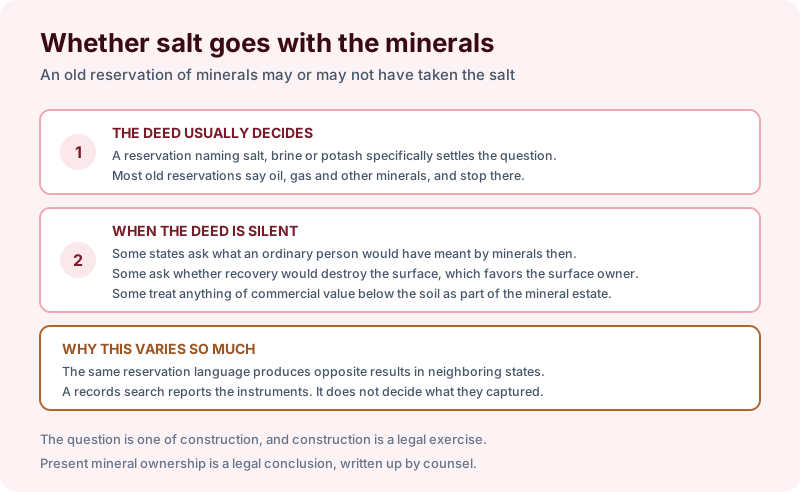
Where the instrument names salt, brine or potash specifically, the question is settled and the search answers it directly. That is the easy case and it is not the common one.
Most old reservations use the standard formula and stop. When the deed is silent, states resolve it differently. Some apply an ordinary meaning test, asking what a reasonable person at the time would have understood minerals to include, which frequently excludes salt. Some apply a surface destruction test, treating a substance whose recovery would consume or destroy the surface as belonging to the surface owner. And some treat anything of commercial value lying below the soil as part of the mineral estate.
The same reservation language therefore produces opposite results in neighboring states. That is not a defect in anybody’s drafting. It is the accumulated result of a century of courts answering a question the parties never asked. A records search reports the instruments and their exact language. It does not decide what those instruments captured, and it is the same division of labor described in a mineral title opinion versus a records search.
How they are produced
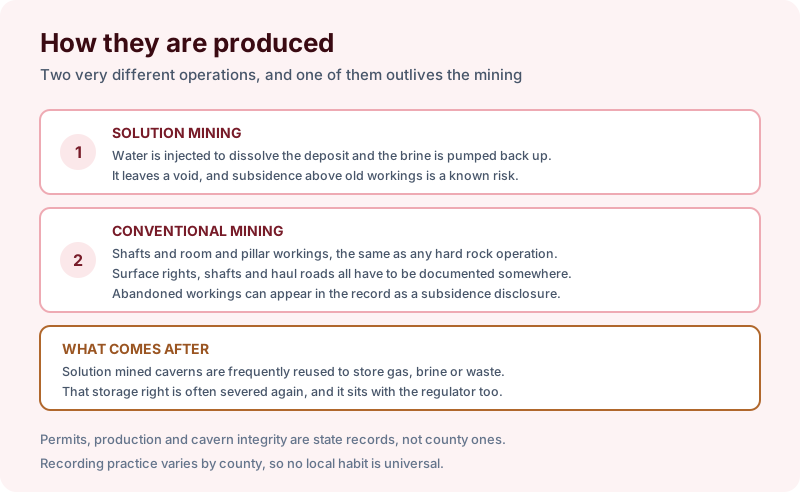
Two operations, and they leave different traces.
Solution mining injects water to dissolve the deposit and pumps the brine back to the surface. It is cheap and it leaves a void, which is why subsidence above old workings is a documented risk in several producing regions. Conventional mining uses shafts and room-and-pillar workings, and requires surface rights, shaft locations and haul roads that have to be documented somewhere.
What comes afterward matters as much as the mining. Solution mined caverns are frequently reused to store natural gas, brine or waste, and that storage right is often severed again into a separate interest. The analysis there overlaps with pore space and carbon storage rights, which is a distinct estate in a growing number of states.
Permits, production figures and cavern integrity data are all state regulatory records rather than county ones. Recording practice varies by county, so nothing about how one county handles a subsidence disclosure should be treated as universal.
Why this reaches surface owners directly
Because salt is shallow relative to oil and gas in many basins, and because both production methods interact with the surface in a way that a deep gas well does not. Subsidence, brine handling and haul traffic are surface impacts, and the allocation of those burdens sits in surface use agreements rather than in the severance itself, as set out in surface use agreements and damage payments.
So a surface owner who concludes that the minerals are gone and therefore the question is closed may be wrong twice, since the salt may never have left and the surface burdens are negotiable regardless.
Scoping the search
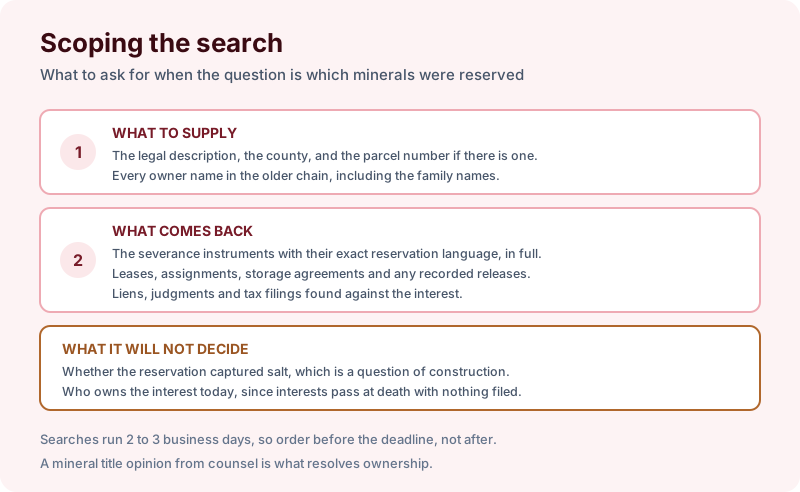
Give us the legal description, the county, the parcel number if there is one, and every owner name in the older chain including the family names. What comes back is the severance instruments with their reservation language quoted in full, the leases, assignments, storage agreements and recorded releases, and the liens and judgments found against the interest. Our search packages set out the available terms.
What it will not decide is whether the reservation captured salt, which is a question of construction for counsel, or who owns the interest today, since interests pass at death with nothing filed in the county. Present ownership is a legal conclusion set out in a mineral title opinion.
The takeaway
Salt and potash sit in the gap between what an old deed said and what a modern operator wants, and the gap is filled by state law rather than by the document. Get the exact reservation language in front of counsel, because that sentence is the whole case. Start the order online, or send us the address and the county and we will tell you which term fits and what a search of that scope would and would not cover before anything is ordered.