Skip to content
AFX Research logo

Know What You Are Looking At

Types of Mineral Rights

Subsurface ownership divides first into the mineral estate and the surface estate, and then into the interests carved out of the minerals. Here are the eight that come up most often, and an honest note about which ones a search of the land records can actually find.

Two questions sort every mineral interest

The first question is whether the minerals were ever severed. While one owner holds both estates they are united, and nothing separate appears in the record. The moment a deed conveys the minerals away, or sells the surface while reserving them, a second estate exists and the two begin travelling through different chains.

The second question is what has been carved out of the minerals since. A lease hands an operator the right to produce for a term. A royalty conveys a share of production without the right to lease. An executive right can be split off on its own. Each carve-out is its own instrument, and they accumulate.

Both questions are answered by the instruments themselves. Those are what a mineral rights search retrieves, so you can read the reserving language rather than infer it.

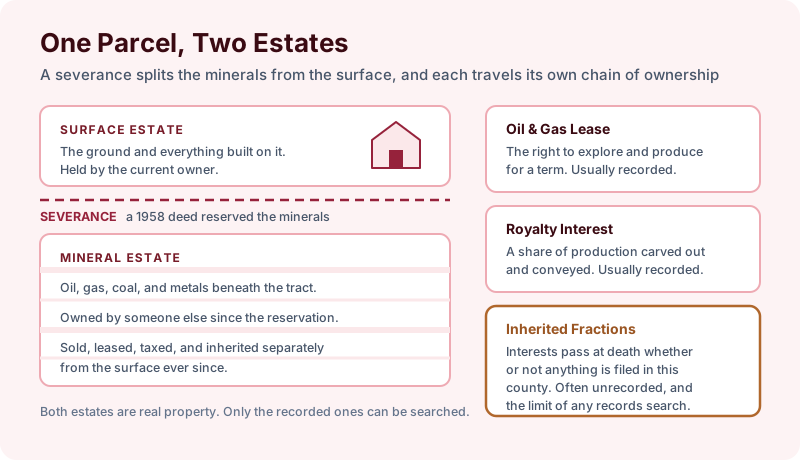
Cross-section diagram of a single parcel split into two estates: the surface estate at the top held by the current owner, and the mineral estate below it held by a different owner after a 1958 deed reservation, with an oil and gas lease and a royalty interest carved out of the mineral estate, and a copper note that inherited fractional interests frequently pass without anything being recorded in the county where the land sits.

Found in the Land Records

Interests created by a recorded instrument

These are created by a document that gets recorded against the parcel. A mineral rights search reports the ones found of record for the term you select, with the instrument attached.

Recorded when severed

The Mineral Estate

The mineral estate is ownership of the oil, gas, coal, metals, and other substances beneath a tract. It is real property in its own right, and it can be owned, sold, leased, taxed, and inherited entirely separately from the ground above it.

When one person owns both the surface and the minerals the estates are said to be united, and nothing separate appears in the record. The moment a deed conveys or reserves the minerals, a second estate exists, and from then on the two can travel through completely different chains of ownership.

Recorded

Severed Mineral Rights

A severance is the act that splits the minerals from the surface, either by a deed conveying the minerals to someone else or by a deed that sells the surface while reserving the minerals for the seller.

Severances are the single most consequential thing a mineral rights search looks for, and they are frequently decades old. A reservation buried in a 1954 warranty deed still controls who owns the minerals today, which is why the search term you choose matters: a 20-year search cannot report a severance that happened in 1954.

Recorded

Surface Rights

Surface rights are ownership of the ground and everything built on it. Where the minerals have been severed, the surface owner holds their tract subject to the mineral owner’s right to get at what they own.

In most states the mineral estate is the dominant estate, meaning the mineral owner has an implied right to use as much of the surface as is reasonably necessary to develop the minerals. How far that right reaches, and what accommodation the surface owner is owed, is set by state law and varies considerably.

Usually recorded

Oil and Gas Leasehold Interest

An oil and gas lease gives an operator the right to explore for and produce minerals for a term, in exchange for a bonus payment and a royalty. It creates an interest in the land, not merely a contract.

Leases are commonly recorded, though some operators record only a short memorandum of lease rather than the full instrument, so the recorded document may not state every term. Expired and terminated leases often stay on the index long after they have lapsed, which is one reason the recording dates in a report matter as much as the documents.

Usually recorded

Royalty and Non-Participating Royalty Interests

A royalty interest is a share of production free of the cost of drilling. A non-participating royalty interest, or NPRI, carves off that revenue share without carrying any right to lease the minerals or to collect bonus.

Royalty interests are carved out of the mineral estate and conveyed separately, so a single tract can carry a mineral owner, several royalty owners, and a lessee at the same time. Each carve-out is its own recorded instrument, and they accumulate over time.

Recorded in the conveyance

Executive Rights

The executive right is the power to sign a lease on behalf of a mineral interest. It can be separated from the interest it controls, leaving one party owning minerals and another holding the right to lease them.

Where the executive right has been severed, finding the mineral owner is not the same as finding the person who can lease. The separation is created in the conveying instrument itself, so it appears only if that instrument is read rather than merely indexed.

Where a Records Search Stops

Interests that may never have been recorded

Some interests move without anything being filed against the parcel at all. If nothing was recorded, no search of the land records will show it. We would rather say that plainly than let a clean report be read as proof that the minerals are unsevered or that the last grantee named is the present owner.

Often unrecorded

Working Interest

The working interest is the operating side of a lease: the right to drill and produce, together with the obligation to pay the costs. It is usually held by an operator and its partners.

Working interests are frequently governed by joint operating agreements and assignments that the parties have no obligation to record, and often do not. A land records search reports the recorded lease and any recorded assignment, but it is not a picture of who is actually paying for and operating a well.

Often unrecorded

Inherited and Undivided Mineral Interests

Mineral interests pass by will and by intestate succession like any other real property, and after a few generations a single tract can carry dozens of undivided fractional owners.

This is the hardest limit of any records search. When an owner dies, the interest passes whether or not anything is ever filed in the county where the land sits, and probate is frequently opened in the state where the person lived instead. A clean search means no severance or transfer was found of record in the term searched, not that the minerals are unencumbered or that the last grantee named is alive.

What to pair with a records search

A mineral title opinion is an attorney's written conclusion about who owns what, drawn from the record a search like ours assembles. State oil and gas regulators hold the permitting and production data that the county recorder does not. A records search shows what was written down and recorded, which is the evidence the other two work from. Whether a particular interest is currently valid, and who holds it today, is a legal question for an attorney licensed in that state, not a conclusion an abstractor draws.

Next Step

Find out which of these are on your parcel

A certified abstractor searches the county land records against the address you give us and reports the mineral conveyances, reservations, and leases found of record over a 20, 30, or 50 year term, with a copy of each recorded instrument attached.

Not sure which term fits? Call 877-848-5337 ext. 138 with the address and we will tell you.

Start Your Mineral Rights Search Today

Certified abstractors search the county land records against your parcel and report the mineral conveyances, reservations, and leases found of record, with a copy of every recorded instrument attached. Order online in minutes, or tell us about the parcel and we will help you pick the search term.

Questions? Call 877-848-5337 ext. 138 or email info@afxllc.com